What happens after a vibe-coded site "just works"
SitePort is a self-initiated project, not client work. It came out of watching people, myself included, hit the same wall after building something with Lovable: the site works, it looks good, but it's locked to a platform nobody but that AI tool can meaningfully edit. I designed and built a converter that turns an AI-generated site into a real, editable WordPress theme, so ownership doesn't have to stop where the AI tool's plan does. It's in the final stretch now, ahead of opening it up.
A finished AI-built site has no way to be handed over.
Convert it into an editable WordPress theme that looks identical.
A working converter, in final QA.
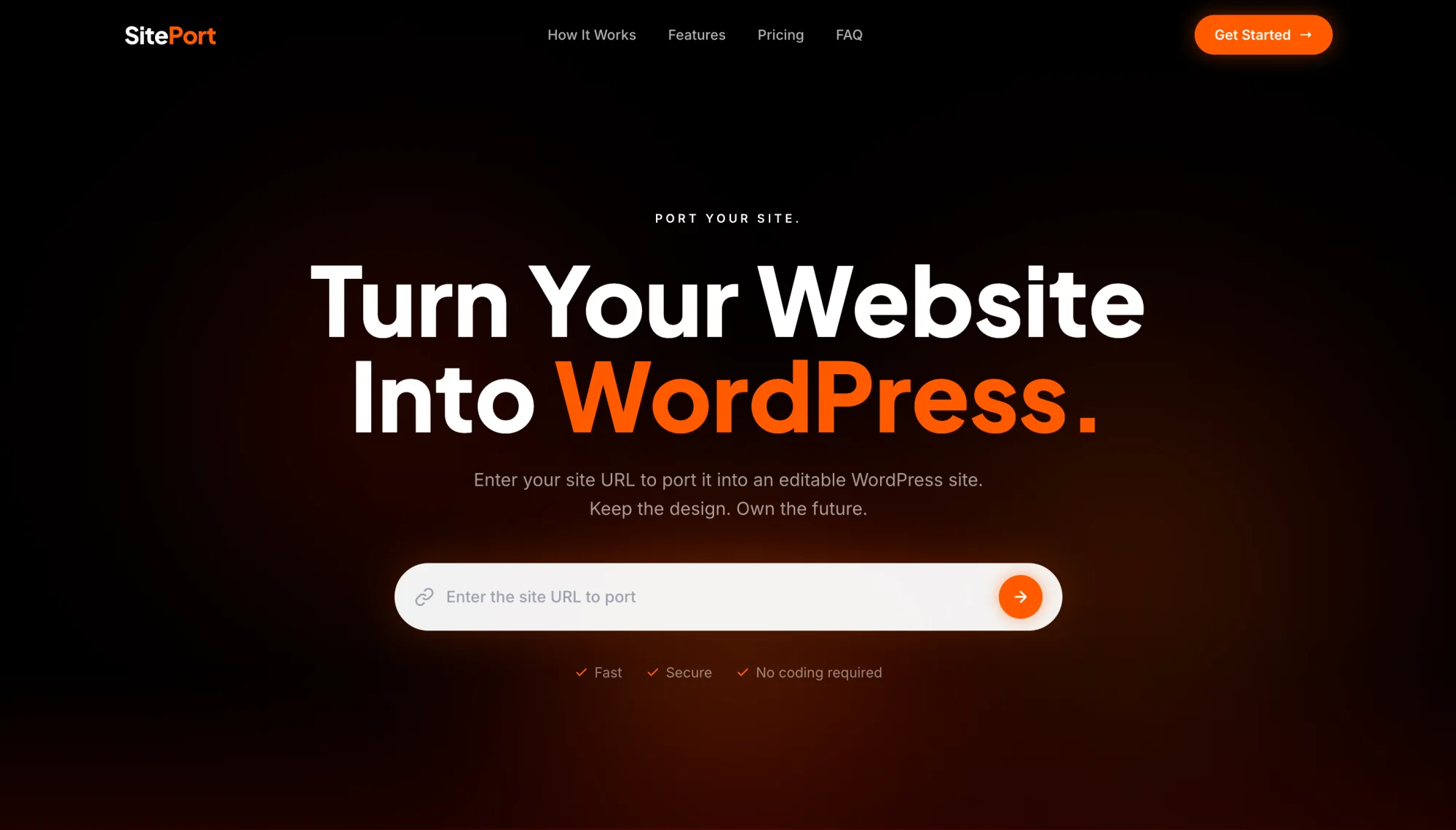
A finished AI site that nobody can take over.
A prompt loop, a stalled handoff or a costly rebuild.
Builderwants to keep improvingClientwants to edit it themselvesBuilt from watching my own and others’ Lovable projects hit the same wall. Illustrated.
Give, convert, get back
The structure turns a locked site into an editable one.
BeforeA finished AI site had no path to being handed over or maintained.
Give it the site
Two ways in
- A site URL
- Lovable site, public
- Upload the code
- For sites a crawl cannot see
Convert
Three steps
- Analyse
- Structure of the site
- Convert
- Into a WordPress theme
- Optimise
- Clean, editable output
Get it back
Yours to edit
- Elementor theme
- Drag and drop
- Looks like the original
- Flagged gaps
- What cannot convert cleanly
- Verified
- Playwright checks the pages
Built from the case study. Each column is a stage of the conversion.
Two ways in, one result
Both paths end in a theme you can edit.
From a URL
A builder with a public Lovable site- StartPaste the site URL
- AnalyseRead its structure
- ConvertBuild a WordPress themeSame lookVisual fidelity is a hard rule
- OptimiseClean up the output
- VerifyA browser checks the pagesVerified, not assumedNot just a screenshot diff
- EditChange it in Elementor
From the code
A site a URL crawl cannot fully see- StartUpload the codebaseA second way inSome routes are hidden from a crawl
- RunAnalyse, convert, optimise
- FlagSee what cannot convertHonest gapsFlagged, not faked or dropped
- EditChange it in Elementor
Built from the case study. The notes explain the design choice.
Three decisions that did the work
Each decision protected trust in the output.
WordPress and Elementor
The editor most freelancers and agencies already know.
Visual fidelity as a hard rule
Visual trust is what lets someone hand a site to a client.
Code upload as a second way in
Some routes are invisible to a URL crawl.
From locked to yours
A path from a finished AI site to an owned one.
The path, before
- A site is locked in the AI tool
- Back to the prompt loop
- The client cannot edit it
- Rebuild in Elementor by hand
- Pay to do the work twice
- Ownership stalls
The path, after
- Gives the URL or code
- Gets a converted theme
- Looks identical, or is flagged
- Edits it in Elementor
- Hands it to a client
- Owns the site
Ownership handed back, not a copy of the site. The output is editable, not just similar.
What I can and cannot claim. SitePort hasn't launched publicly yet, so there's no external adoption or conversion-rate data to cite here. What's above describes what's been built and how the pipeline works, not measured outcomes at scale.
What I would do next
It works end to end. It has not opened publicly yet.
Close the last gaps before opening it up.
See which sites convert cleanly and which do not.
Handle more interactions that map to Elementor.